

Published on June 17, 2026
10 min to read
How AI Content Analysis Predicts Performance Before You Publish

Summarize with AI

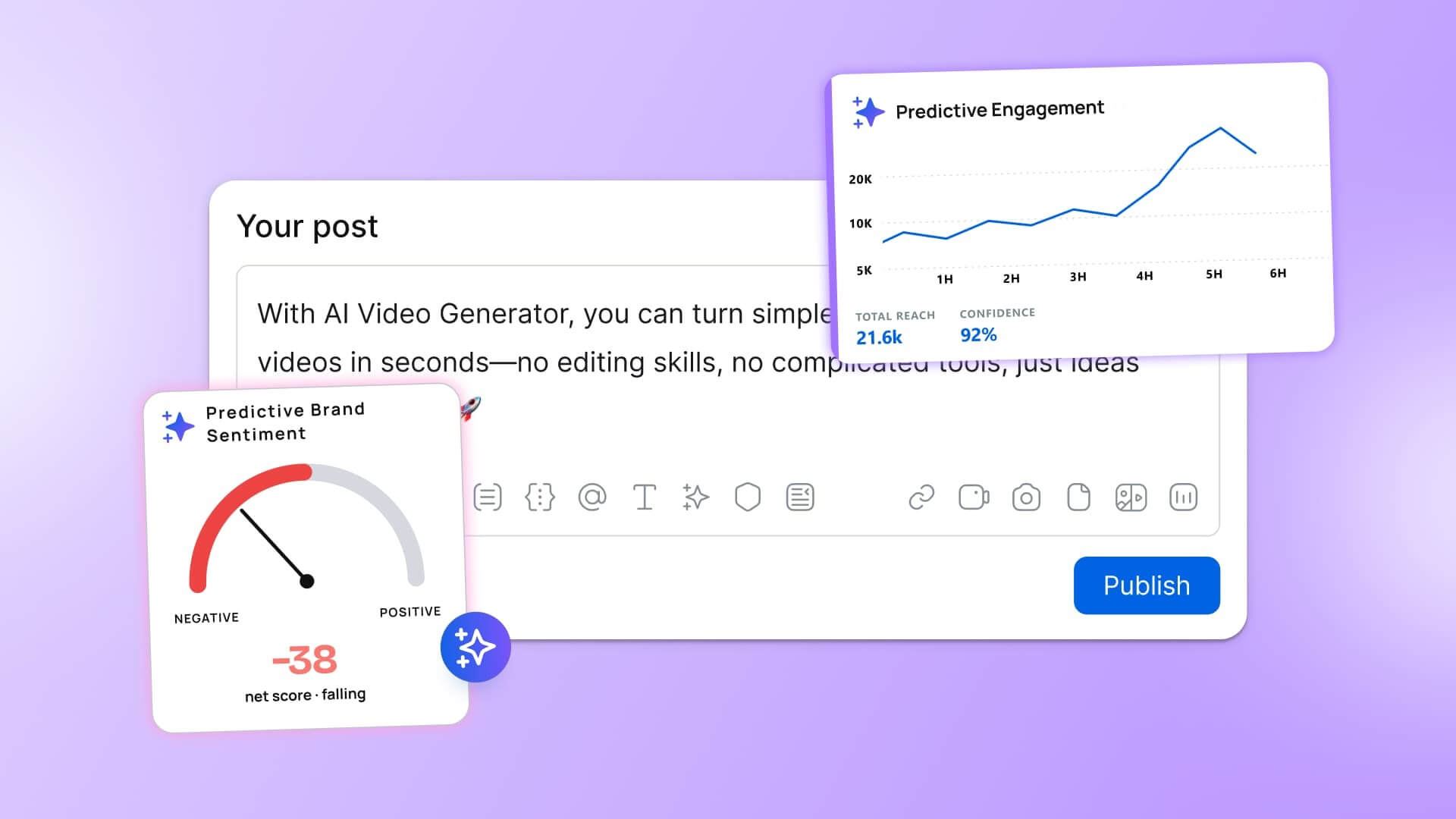
Table of contents
Summarize with AI

ChatGPT

Claude

Perplexity
Share

Vista Social

X (Twitter)


At the start of a busy week, you upload a batch of images and clips. You scan them and pick the strongest ones. Next, you write captions and schedule them across five platforms. Finally, you move on to the next internal fire with your bets already placed.
Then the analytics trickle in over the next few days. About half of what you posted quietly underperformed. By the time you see it, the reach is spent. There is nothing left to do but file it under lessons for next time.
That’s the strange shape of the job. A social manager makes dozens of these bets a week. Until now, there has never been a way to check them before publishing. AI content analysis changes the order of operations. Instead of waiting for a post-mortem dashboard grade, it reads each image and video on upload. This hands you a performance read while you can still act on it.
Table of contents
What is AI content analysis? (And how it flips the traditional workflow)
AI content analysis evaluates an image or video before it is published. It checks how well it will perform, where it fits, and whether it stays on-brand.
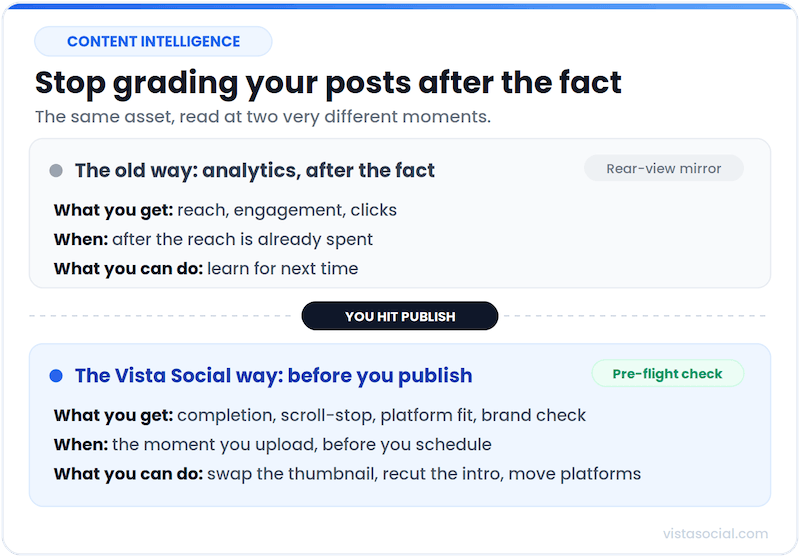
Traditional social media analytics can’t warn you of what’s to come. It tells you what already happened after the post ran its course. While this helps the next round, it can’t rescue the piece you just published.
AI content analysis flips that sequence. Instead of scoring past results, it scores the content itself before anything goes live. It reads the creative like an experienced strategist and provides clear, actionable signals.
This technology differs from predictive analytics, which forecasts performance from historical results and platform trends. Content analysis does not lean on past numbers. The content right in front of it serves as the data.
Why teams are forced to judge content blind
A pre-publish read matters because the problem it solves is bigger than the catch-all complaint that social media is hard.
Social is a visual medium
Open any feed, and it’s mostly Reels, TikToks, Shorts, LinkedIn videos, and carousels now. The bar for stopping a thumb climbs every quarter, and most of that work falls on the image or the first frames of a video, long before anyone gets near your caption. The visual is the whole pitch. Miss there and the caption never gets read.
The volume makes hand-checking impossible
Most social teams run one to three people deep, shipping platform-specific assets across five or more networks every week. That’s dozens of instinct calls under deadline. Eyeballing one hero image and forming an opinion is easy enough, but judging forty assets across six platforms by feel is a different job, and it’s simply too big to do well by hand.
You get one shot at attention
Short-form video lives or dies in the first few seconds, and much of it plays on mute while people scroll, so the opening frame carries the whole weight with no preview of how it lands. Instagram’s Adam Mosseri has pointed to watch time as a critical signal for Reel reach. Knowing whether people will keep watching, then, is about the most valuable thing you can learn before you post.
Video is the hardest call of all
A static image you can size up at a glance. A thirty-second video is a different animal, with a hook, a pace, captions, audio, and a payoff that all have to land, and none of it reads reliably from one quick scrub before you schedule.
One of the many signals that decides a video’s fate is whether people watch it to the end. Instagram’s own ranking explainer, for instance, lists watching a reel all the way through as one of the most important predictions it makes when deciding what to recommend, which makes completion the engine of reach rather than a vanity metric. That’s the one signal teams stay blind to going in.
The dashboard is a rear-view mirror
Every standard analytics tool reports on what already happened. By the time the numbers land, the post has spent its reach. You can learn lessons for next time, but you cannot fix the current post. That is the entire frustration in a single sentence.
Brand risk and accessibility
Two more costs build as volume grows. The first is brand risk. Publish more AI-generated content and off-brand assets slip through, and a single bad post is public and permanent. Manual review is the first thing to buckle when volume spikes.
The second is organization and access. Libraries balloon into thousands of unnamed, unsearchable files, and most social images still ship with no alt text at all.
Put it together and the shape of the problem becomes clear. Social managers have the effort and the talent. However, they lack critical information at the moment of decision. Everything worth knowing about a piece of content has always arrived too late. That is exactly the gap AI content analysis closes.
How AI content analysis works
The mechanics are less mysterious than they sound. AI vision models evaluate assets like a seasoned strategist. They analyze composition, subject, color, hooks, pacing, captions, and audio. Then, they turn these elements into structured scores and plain-language signals.
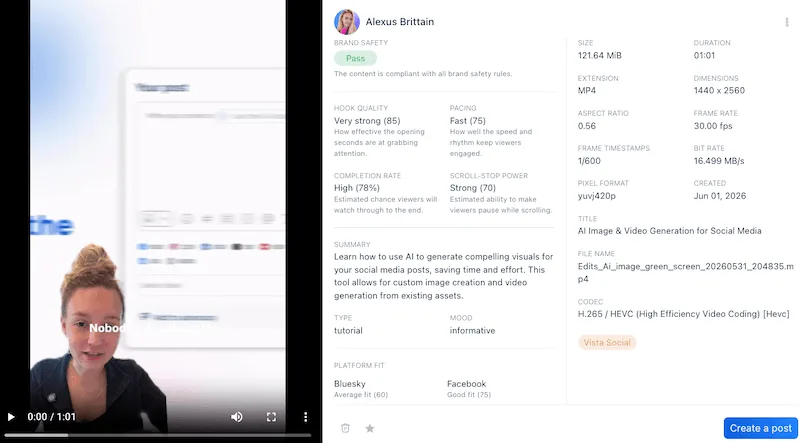
In Vista Social, this process runs automatically on every upload. Simply drop a file into your media library or post composer. Click it, and an insights panel appears in the preview within a few minutes. What comes back depends on the asset:
- Video assets provide: An estimated completion rate, a scroll-stopping score, pacing signals, and an auto-written title and description.
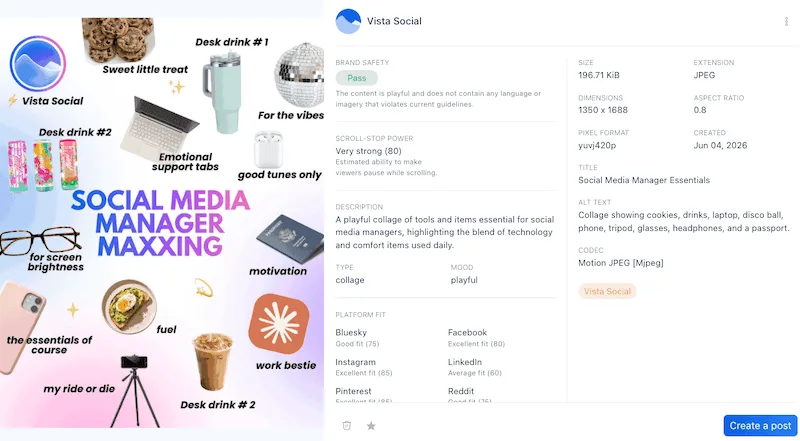
- Image assets provide: A scroll-stopping score, a content-type read, visual strengths, weaknesses, and auto-written alt text.
- Both asset types provide: A short summary and a read on which platforms the asset fits best.
Predicting how your videos will perform
Video earns its own section. It is the hardest format to judge and carries the highest stakes. In Vista Social, the pre-publish read breaks a clip into key components. If you approve other people’s work, this saves massive time. You can review thirty clips without watching each one to the end. The weak sections surface on their own.
A real example
None of this is theoretical. The Institute of Human Anatomy, an education brand with more than 24 million followers, spent six months reworking how its videos open after a machine-learning analysis of its hooks found they leaned too hard on a single curiosity trigger, which was costing it viewers.
Once the team varied those openings, one reworked video held 72% of its audience at the thirty-second mark, drew more than 400 new subscribers, and stacked up 26,700 hours of watch time, as reported by Entrepreneur. The lesson carries to any feed. The teams that read a clip’s hook before it ships, instead of guessing, are the ones who stop losing people in the first three seconds.
Hook strength
The first few seconds decide whether anyone watches the rest of your clip. The analysis tells you if the open earns attention or demands too much from the viewer. This catches a weak intro before it costs you the whole video.
Pacing and energy
A clip can open well but sag in the middle. That middle section is where most viewer drop-off happens. The analysis maps energy across the video timelines. It flags exact stretches where attention is likely to leak so you can tighten the edit.
Completion-rate prediction
This is the metric that matters most, an up-front estimate of whether viewers will stay to the end. For the ranking reasons above, that number tracks closely with how far a video travels, so a low estimate is a warning you can act on before you post. It trades hope for a clear read on where you’re likely to lose people.
Captions and sound-off readiness
Much of your feed video is watched on complete mute. A clip that leans too heavily on audio can fall flat in silence. The tool checks whether it still communicates clearly with the sound turned off. This evaluation includes verifying your captions. It is the exact logic that makes short-form video work in the first place.
Scoring image power and matching assets to the right platform
Vista Social gives images the same rigorous treatment. It reads them for the exact qualities that stop users from scrolling.
What the analysis reads in an image
The system evaluates scroll-stopping power, composition, color harmony, and visual complexity. It also identifies the content type, such as promotional or educational. Instead of a black-box number, you receive concrete strengths and weaknesses. This is the exact feedback you can hand straight to a designer.
Per-platform fit
The same asset rarely performs equally across different channels. The read scores your asset across all target networks. It covers Instagram, TikTok, LinkedIn, YouTube, and Pinterest. This lets you post each piece exactly where it fits best. You no longer have to blast one generic version everywhere. It also settles weekly team debates with an objective starting point.
Keeping every post on-brand
Brand consistency grows harder at the exact moment you scale your content production. As output rises, the odds of off-brand assets slipping through climb. Hand-checking every single asset is the first thing to break during volume spikes.
We should be precise about what the performance read does and does not do. It tells you how a piece will perform and where it fits. However, it does not judge whether it follows your brand rules. That line matters. A tool that blurred the two would be worse than one that owned the difference.
Brand checking operates as a completely separate layer. Vista Social features a Brand Safety and Compliance policy. When switched on, files are scored against guidelines the moment they upload. Anything off-policy is flagged before it goes out. This tool runs side by side with the performance read. You set the policy, and the automated check applies it the same way every time. No human reviewer can maintain that level of consistency at scale. This Enterprise feature helps teams manage large, distributed groups easily.
A searchable and accessible library by default
On upload in Vista Social, every asset gets an auto-written title, description, and alt text, all of it editable. That turns a wall of identical file names into a library you can actually search, and your posts ship as accessible by default instead of waiting on someone to remember alt text late in the day.
Where this automation saves you hours
Performance prediction grabs headlines, but the real win is eliminating tedious manual chores. Most of these tasks were never even counted as real work. Here are a few jobs the system completely absorbs:
- Reviewing external batches: Approving a freelancer’s or a junior’s thirty assets used to require opening every file. Now, weak clips and flat images surface automatically. Your valuable attention goes only to items needing a human touch.
- First-pass creative feedback: The strengths and weaknesses read exactly like feedback notes to a teammate. They flag issues like a missing call to action or a busy background. These generate for every asset automatically. This helps team coaching scale past manual limits.
- Searchable libraries: Auto-written titles and descriptions turn walls of identical file names into searchable data. You can easily find files three months later without sitting down for manual data entry.
- Consistent alt text: Descriptions are generated for every image automatically. This ensures accessibility happens at volume instead of slipping to next week’s to-do list.
Sanity checks for solo managers: Solo social media managers get a much-needed second opinion. It provides the feedback they would otherwise only get from a creative director.
None of this work is glamorous. That is exactly the point. It targets the invisible overhead of running social media at scale. These small chores eat up your week. Handing them to an automatic process frees you for creative, human work.
From prediction to performance
A pre-publish read works best when integrated directly into your daily workflow. It shouldn’t live in a separate tab you forget to open. That is the exact case Vista Social is built to make.
The platform you already use for publishing analyzes every asset on upload. It scores items for performance and platform fit. It writes titles, descriptions, and alt text automatically.
With Brand Safety enabled, it also checks your guidelines. All of this happens before you schedule across networks. Because these tools share one place, the workflow loop closes completely. It perfectly complements historical predictive analytics. Each round teaches the next instead of resetting every single week.
How to build a pre-publish check into your workflow
You do not need to overhaul your entire workflow to benefit. Three simple priorities do most of the work:
- Run the read on every upload: Make it automatic as assets enter your library. This ensures information is ready when making decisions, not after the post runs.
- Target your worst blind spots first: Prioritize video completion, brand safety, and accessibility. These are the three areas where instinct and manual reviews fail most.
- Let automation manage the volume: Lean on automated reads to scale your workflow. This allows you to weigh forty assets as carefully as a single one.
Stop posting blindly
The social media deal has always been the same. You make a best guess and publish. Then, you find out if you were right when it is too late to matter.
A pre-publish read changes the timing of that truth completely. You see how a piece will perform up front. You learn where it fits and whether it stays on-brand. Best of all, you get this data while you can still act on it. This turns stressful guesswork into a calm, clear decision. The hardest part of social media was never the talent. It was getting information in time to use it.
Vista Social reads every image and video on upload. It forecasts performance and tracks platform fit. The engine also writes your metadata automatically. Finally, it helps you schedule, publish, and measure results. You can now see what your content scores before you post it.
Frequently asked questions about AI content analysis
What is AI content analysis?
AI content analysis evaluates an image or video before publication. It reviews expected performance, platform fit, and brand alignment. Standard analytics reports on a post after it runs. In contrast, this reads the creative up front so you can act immediately.
Can AI predict how a social media post will perform?
The tool gives you a directional read rather than a guarantee. It analyzes key attention drivers like video hooks or image scroll-stopping power. From there, it estimates performance and flags weak spots early. Treat it as helpful guidance to improve your odds.
How is AI content analysis different from social media analytics?
Standard analytics reports on a post after it runs, while this reads the creative up front so you can act on it right away.
Is AI content performance prediction accurate?
The prediction engine is accurate enough to be genuinely useful. It remains honest about being directional rather than absolute. The tool reliably flags weak assets and highlights high performers. However, no software guarantees results. Real-world performance always depends on timing, audience, and luck. Use it to improve your daily odds.
Try Vista Social for free
A social media management platform that actually helps you grow with easy-to-use content planning, scheduling, engagement and analytics tools.
Get Started NowAbout the Author

Content Writer
Orion loves to write content that refuses to be boring. As part of Vista Social, he helps brands, creators, and agencies stop doom scrolling and start winning with social media. When he's not in front of a keyboard, he's watching films in IMAX with his wife, dissecting football tactics (the European kind), and getting lost in a good book.
Loading related tools...

The most complete social media management platform for teams who demand more.






Tools
PublishingAnalyticsEngagementIntegrations
FacebookInstagramLinkedInRedditSnapchatThreadsTikTokX (Twitter)YouTubeMCPVista Page (link-in-bio)All IntegrationsCopyright © 2026 Vista Social LLC. All Rights Reserved.